How a communication agency finds its first B2B clients?
Word of mouth runs dry eventually. Here is how a young communication agency builds a steady flow of B2B clients, step by step.
Word of mouth is no longer enough
Most communication agencies start thanks to their network. A former employer, a classmate, a referral. That is normal, and it is even healthy at first. The problem comes when that network dries up: the first contacts are exhausted, referrals become rare, and the agency finds itself with no pipeline for the months ahead.
At that exact moment, two agencies out of three wait for the phone to ring. The third one goes out and actively looks for clients. That is the one that builds a lasting business.
Finding your first B2B clients outside your network is not a mystery. It is a method, not a sales gift. Here is how to go about it.
Their LinkedIn and their email, in one sentence.
Marketing directors in Nantes, companies of 20 to 200 employees
Free
Define precisely who you want as a client
The most common mistake young agencies make is trying to talk to everyone. "We do communication for all kinds of companies." The result: you speak to no one in particular, and your message stays vague.
The first task is to define your ideal client with precision. Not "SMBs", but for example "consulting firms of 5 to 20 people in your region that have no in-house marketing team". The sharper the target, the more effective your outreach, because you will speak their language and address their problems.
To define this target, start from your best current clients, even if they came from your network. What is their industry? Their size? What makes the collaboration work well? These common points draw your target.
Identify the right companies to contact
Once the target is defined, you need to find the companies that match it. This is where many agencies waste a huge amount of time, digging through LinkedIn profile by profile or buying outdated lists.
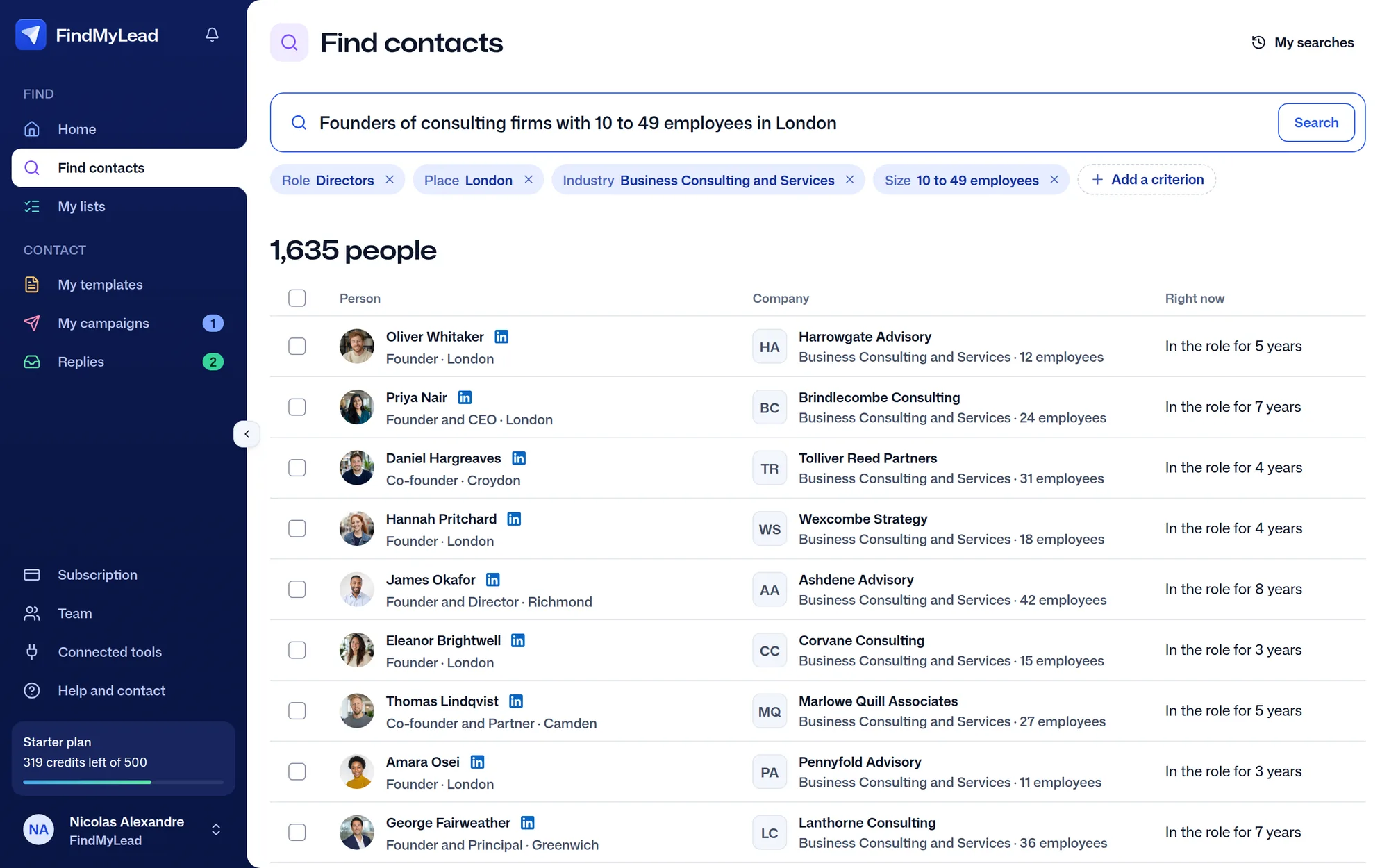
The right approach starts from people, not from a list of companies. Describe who you want to reach: the role (founder, head of marketing), the industry, the company size and the city. By combining these criteria, you get the names of the people who match your ideal client, not companies where you still have to find whom to contact.
One often overlooked point: the company's age. Recent, growing companies often have unmet communication needs and no dedicated agency yet. Their LinkedIn page shows the year they were founded: check it before you write.
Find the right contact
Contacting a company is useless if the message does not reach the right person. In a small structure, it is often the founder who decides on communication. In a larger one, it will be the marketing or communication manager.
The goal is to get that person's name and a way to reach them directly, ideally their professional email. A message that lands in the decision maker's inbox is worth infinitely more than a generic contact form buried in a shared mailbox.
Send a message that makes people want to reply
This is where everything is decided, and where most agencies get it wrong. They send a message centered on themselves: "We are a communication agency, here are our services, contact us."
No one replies to that. A good first message is about the prospect, not about you. It shows you looked into who they are, asks a simple question about their situation, and suggests a light next step. The goal of the first contact is not to sell a service, it is simply to get a reply and open a conversation.
A few principles that work:
Keep it short. An effective first prospecting email fits in a few lines. No one reads a wall of text from a stranger.
Personalize for real. One sentence showing you know their business changes everything. "I saw your recent brand launch" is worth a hundred times more than "Dear Sir or Madam".
Ask a question rather than selling. "How do you handle your communication today, in-house or with a provider?" invites a reply without committing to anything.
Follow up, because the first reply rarely comes from the first message
Most replies in prospecting do not come from the first email, but from follow-ups. A busy prospect who did not answer is not necessarily uninterested, they simply forgot or postponed.
A follow-up a few days later, bringing something new rather than repeating the first message, often doubles the reply rate. Do not stop at the silence of the first send.
Make the effort regular
The real secret is not to send one wave of messages and then wait. It is to make it a regular habit. Setting aside a fixed time each week to identify new targets, reach out, and follow up. That regularity is what turns prospecting into a predictable flow of clients, instead of depending on the ups and downs of word of mouth.
In summary
Finding your first B2B clients as a young communication agency comes down to five steps: define your target precisely, identify the right companies through official data, find the right contact, send a personalized message centered on the prospect, and follow up consistently.
It is not a matter of innate sales talent, it is a method any agency can apply. And once the process is in place, it runs, independently of the ups and downs of word of mouth.
That is exactly what FindMyLead lets you do: describe your ideal client in one sentence, see the matching directors with their LinkedIn, and launch a campaign where the AI writes the LinkedIn invitation and the email for each of them. Enough to build your pipeline without spending your days on it. Step by step: finding your first B2B clients without a sales team.