IT service providers: how to find new clients in 2026
A healthy IT services firm rarely lives off its prospecting. It lives off its network, until the day that network stops being enough. Here is how to build a predictable pipeline when you are an IT provider with fewer than 20 people.
An IT services company that runs well rarely has a sales team. It has a founder who handles technical work, hiring and admin, and who wins deals because a former client changed jobs, because a peer was overloaded, or because a partner passed along a recommendation.
It works. Until it stops being enough.
The problem with word of mouth is not its effectiveness. It is that you cannot steer it. You do not decide when it produces, how much, or on which kind of engagement. When a large client represents a third of your revenue and brings the work in house, your network does not fill that gap on demand.
Here is how an IT services company with fewer than twenty people builds a flow of new clients it controls.
Why the usual channels work poorly for a small provider
Public tenders. They are visible, structured and reassuring. They are also the home turf of large integrators with teams dedicated to writing responses. You spend days answering, you get compared on price, and the specification was sometimes written with a competitor. Useful, but not your main engine.
Trade shows. High cost, long cycle, and many visitors who do not decide. On a tight budget, the return is hard to measure and arrives late.
Paid advertising. The keywords in your sector, managed services, cybersecurity, custom development, have been bought for years by well-funded players. A budget of a few hundred euros a month carries little weight there.
What remains, and what works at your scale, is direct and targeted outreach. Provided you do not do it the way everyone else does.
Their LinkedIn and their email, in one sentence.
Directors of manufacturing companies in Lyon, 50 to 250 employees
Free
The one thing that matters: narrow your target
This is where almost every IT provider goes wrong, and it determines everything else.
Ask an IT services founder about their target and the answer is often “SMEs”, sometimes “SMEs in our region”. That is a non-answer. These SMEs have nothing in common, and a message designed for all of them speaks to none.
A usable target crosses three dimensions:
- A precise sector. Not “healthcare”, but medical testing laboratories. Not “retail”, but pharmacies. Not “manufacturing”, but plastic parts makers.
- A geographic area. One or two départements, not the whole of France. For managed services with on-site support, proximity is a decisive argument.
- A size. The number of workstations sets both the need and the budget. A three-person business has no infrastructure problem. A fifty-person one probably already has a provider.
“Accounting firms in Loire-Atlantique with 10 to 49 employees” is a target. “SMEs” is not.
On a target this narrow, you know your contact’s trade, their software, their regulatory constraints and the incident that costs them most. Your message stops being generic. And your first client becomes a reference for the next fifty, because they look alike.
Where to find the people in this target
Once the target is set, you need names. Not a list of companies: the person who picks the IT provider in each one.
Who to aim at. In a company under 50 people, there is rarely an IT director. The director chooses, sometimes with the finance director or the office manager who handles contracts. Above 50 employees, look for the IT director or IT manager.
How to find them. Describe them by job, company size and place, then add the sector. For example: “Directors of accounting firms with 10 to 49 employees in Loire-Atlantique”, or “IT directors of companies with 50 to 250 employees in Nantes”. LinkedIn’s people search filters by place and industry; company size needs Sales Navigator.
What to check. A job title does not tell everything. A “gérant” may run a company with no staff, an “IT manager” may be a technician with no budget. Read a sample of your list before writing to anyone.
Sites that republish the public registers, such as Pappers, give the director’s name for a company you already know. They say neither who handles IT nor how to reach that person. Our guide to finding a company’s director, HR or finance director covers these methods.
The message that opens a door
Your prospect already receives pitches. What makes them reply is not your presentation, it is the precision of your observation.
Three principles are enough.
Do not talk about yourself first. “We are an IT services firm specialising in managed services and cybersecurity since 2015” says nothing another firm could not write. Open on their context: their sector, their constraint, their area.
Ask a real question. A first message that asks for a meeting asks too early. A simple question they can answer in one line gets more replies. “Today, is your IT managed in house or by a provider?” is a question a director answers readily.
Keep it short. Five lines readable on a phone. No attachment, no brochure, no booking link in the first message.
And plan follow-ups. Many replies come at the second or third message. Our 3-email follow-up sequence gives a template.
Rhythm matters more than volume
Prospecting rarely fails for lack of ideas. It fails because it stops as soon as work picks up.
The pattern is familiar: three weeks of sending, two engagements signed, nobody prospects for three months, and the gap reappears the next quarter.
A modest, steady amount beats an intense campaign that gets dropped. Block a fixed slot every week, handle a volume you can keep up in busy periods, and leave it alone.
The mistakes that cost the most
- Targeting too broadly to feel safe on volume. A thousand vaguely relevant contacts take more work and damage your sending domain, for fewer useful replies.
- Writing to the switchboard. A contact@ address rarely reaches the director.
- Treating prospecting as a one-off project instead of a routine.
- Neglecting address quality. Invalid addresses hurt the deliverability of your whole domain: verify before sending (see our guide to email deliverability).
To start this week
Pick a sector you know, because you have at least one client in it. Limit it to one or two départements and a headcount range. Find a hundred people who match exactly, the director or IT manager of each company, and write them a five-line message that asks a single question.
You will not get a hundred replies. You will get a few, and those conversations will tell you whether your target is the right one.
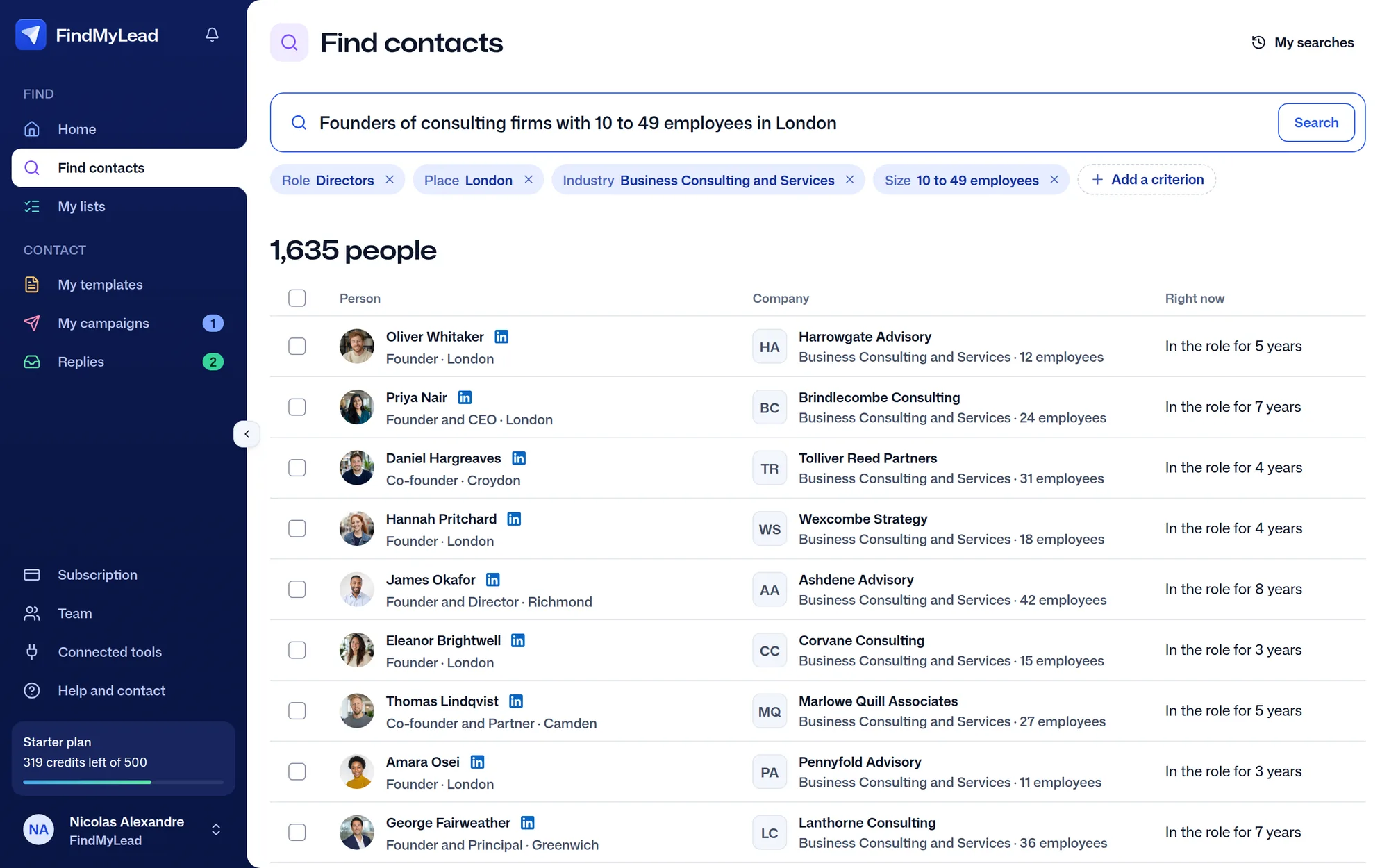
On FindMyLead, you describe these people in one sentence: job, place, company size, sector. You see for free how many there are, with their job, company and LinkedIn profile. Example: “Directors of consulting firms with 10 to 49 employees in Île-de-France”, 1,326 people in October 2026 (the founders’ use case). A credit pays for one contact and their LinkedIn profile; their work email is looked up at no extra credit, found or not. The AI writes a LinkedIn message and an email for each one, which you review.
Frequently asked questions
How does a small IT services firm find clients without a network?
It picks a narrow target: one sector, one or two départements, one company size. It writes to the person who chooses the provider, with a short message that asks a question, and it prospects every week.
Who should I write to in an SME to sell managed IT services?
Under 50 employees, the director, who usually chooses. Above that, the IT director or IT manager, and sometimes the finance director who signs the contracts.
Should a small IT firm answer public tenders?
Occasionally, when the need matches your expertise exactly. As a main engine, no: you are compared on price against large integrators.