Prospecting for consulting firms: how to fill your pipe without a network
Your network brings the first engagements, then it plateaus. Here is how a consulting firm builds a steady, predictable commercial pipe.
Your network brings the first engagements, then it plateaus
Almost every consulting firm is built first on its network. A former employer who becomes a client, a peer referral, a contact met at a conference. It makes sense: consulting is a trust business, and trust flows through relationships.
The problem is that a network has a limit. Once the first contacts are converted, growth slows down. The firm becomes dependent on word of mouth, a channel it does not control and cannot summon on demand. Good months alternate with dry spells, and it becomes impossible to forecast the pipe three months out.
Breaking free from this dependency does not mean abandoning your network, which remains valuable. It means adding a channel you control: active prospecting. Here is how a consulting firm sets it up without sacrificing its billable time.
Their LinkedIn and their email, in one sentence.
Directors and HR directors in Paris, companies of 50 to 250 employees
Free
Clarify what type of engagement you want to sell
The first mistake firms make when they start prospecting is staying generalist. "We help companies with their strategic and operational challenges." This message triggers nothing, because it speaks to no one in particular.
A firm that prospects effectively knows exactly which engagement it sells, to what type of company, and to solve what specific problem. For example: supporting industrial SMBs of 50 to 200 people through their digital transformation. The sharper the offer, the more the message lands, because the prospect recognizes themselves immediately.
To find this angle, look at your most successful and most profitable past engagements. What type of client, what industry, what problem? That is often where your most sellable positioning lies.
Identify the companies that have this need
Once the offer is clarified, you need to find the companies that match. This is the step where firms waste the most time, searching manually online or working through purchased and outdated lists.
The effective approach starts from people, not from a list of companies. Describe who decides on your engagement: the role (CEO, HR director, CFO), the industry, the company size and the region. By combining these criteria, you get the names of the people who match your engagement target, not companies where you still have to find whom to contact.
Signs of growth are particularly useful for a consulting firm. A company that is hiring, has just raised funds or opened a new site often has support needs and a budget to match. Its job offers and announcements show on its LinkedIn page: those are priority targets.
Reach the right decision maker
In consulting, the right contact is almost always an executive: the CEO in an SMB, a department head in a larger structure. They are the ones who decide to hire a firm, and they are the ones you must reach directly.
The challenge is to get the decision maker's name and professional email, so your message lands in their inbox rather than in a generic contact form. A message that reaches the executive directly is worth incomparably more than an approach lost in a switchboard.
Write a first message that inspires trust
Consulting sells on credibility, and your first message is your first proof. If it is generic and centered on you, "our firm has been supporting companies for X years", it stands out from nothing.
An effective message shows you understood the prospect's situation before even talking about yourself. A sentence referring to their industry, their recent growth, their likely challenge, changes everything. Then you ask an open question rather than pitching a service. The goal of the first contact is not to sell an engagement, it is to open a conversation between equals.
A few principles:
Stay sober and professional. Consulting is not aggressive selling. A calm, relevant tone inspires more trust than a sales pitch.
Show that you understand their business. This is your best credibility asset. An executive immediately senses whether you know their industry.
Offer a conversation, not a quote. "Would you be open to a 20-minute conversation on this topic?" is far more engaging than laying out an offer.
Follow up consistently
Executives are busy, and a lack of reply is almost never a refusal. Most prospecting meetings come from a follow-up, not from the first message. A firm that follows up regularly and relevantly, bringing a new angle each time, lands conversations that others let slip through lack of follow-through.
Make prospecting a routine, not an emergency
The classic trap for a consulting firm is to prospect only when the order book empties. By then it is already too late, because the consulting sales cycle is long. A steady pipe is built by prospecting a little every week, even when you are busy, especially when you are busy.
That regularity is what turns a firm's business development from a source of anxiety during dry spells into a controlled, predictable flow.
In summary
Filling your pipe without depending on your network, for a consulting firm, rests on a clear method: clarify the offer and the target, identify matching companies through official data, reach the decision maker directly, send a credible first message centered on the prospect, and follow up consistently.
The network remains an asset, but it is no longer enough to grow a firm. Active prospecting is the channel that puts you in control of your growth.
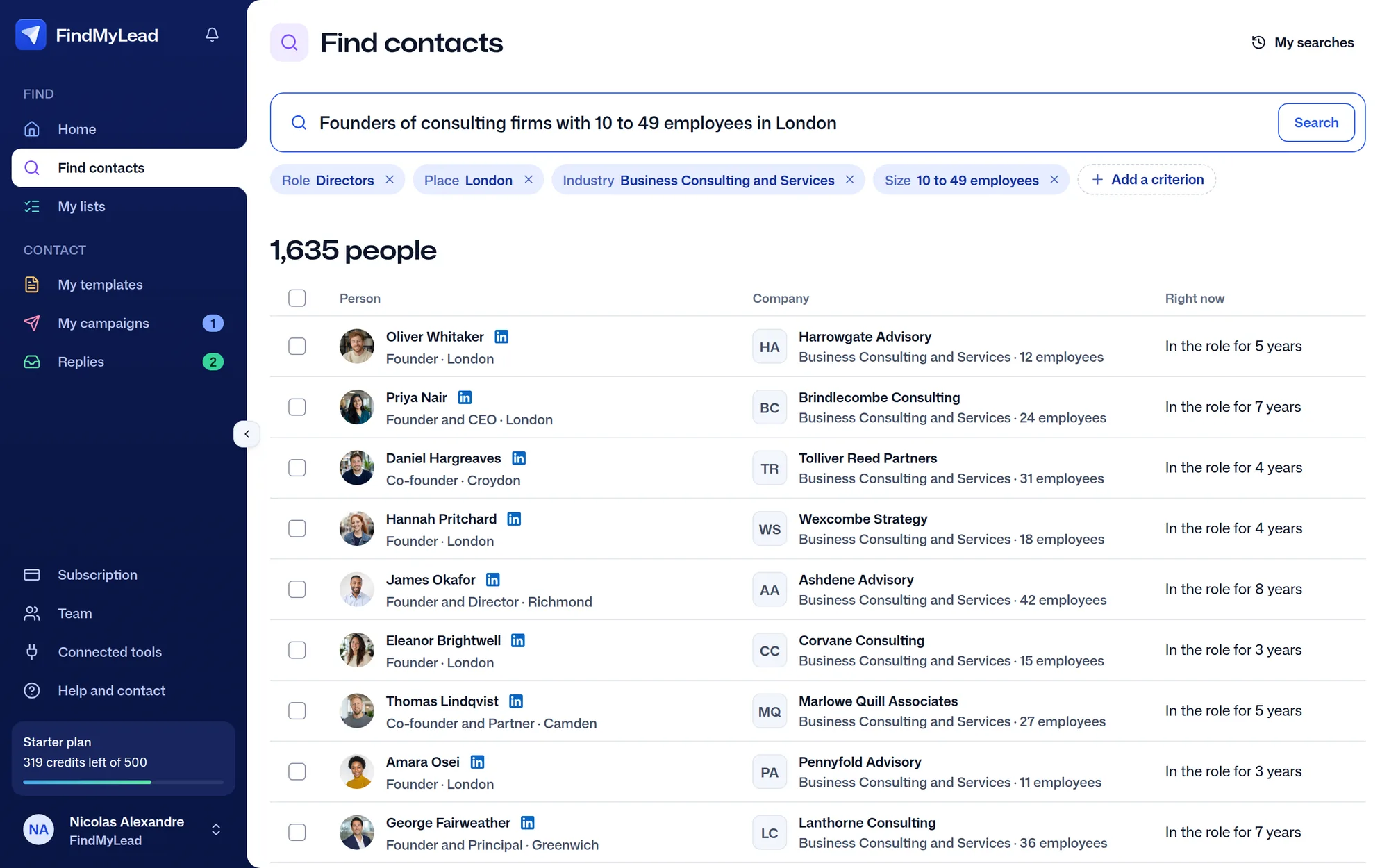
That is exactly what FindMyLead offers consulting firms: describe your ideal client in one sentence, see the matching directors with their LinkedIn, and launch a campaign where the AI writes the LinkedIn invitation and the email for each of them. Enough to build a steady pipe without sacrificing your billable time. Step by step: finding your first B2B clients without a sales team.